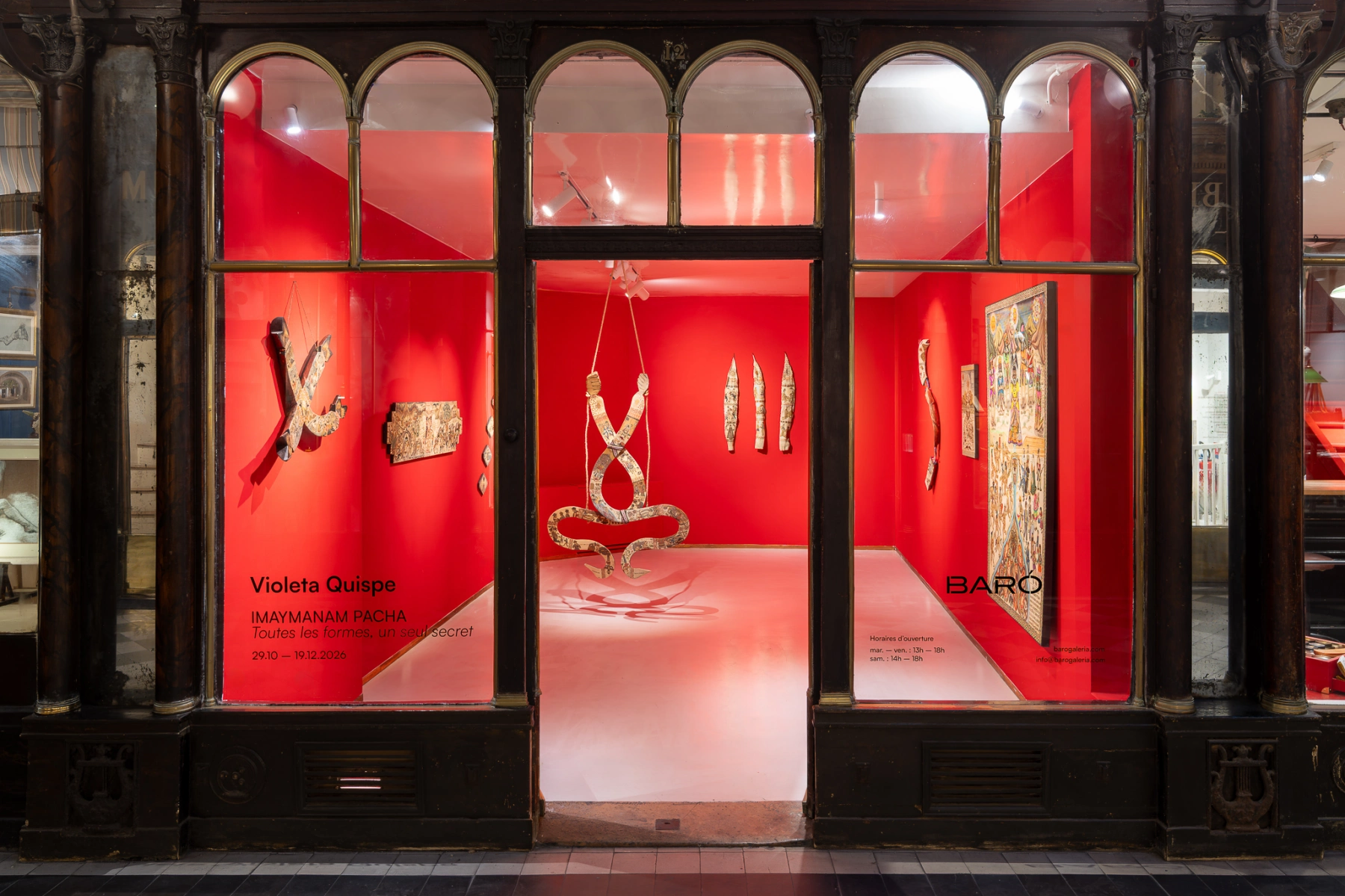

Violeta Quispe de Sarhua (b. 1989, Lima) arrives at Baró in Paris with a certain momentum. She was in the 60th Venice Biennale, and two French regional collections have recently acquired her work. IMAYMANAM PACHA, Toutes les formes, un seul secret, curated by Rolando J. Carmona, is her first solo exhibition in the city. It gathers around ten recent pieces: paintings on wood, reliefs, and works that edge toward sculpture and installation.
Painting handed down
Her starting point is the Tablas de Sarhua, painted wooden boards that tell the life, rituals, and memory of the Quechua community of Sarhua in Ayacucho through scenes and inscriptions. For a long time this was a male practice. Her mother belongs to the first generation of women who began painting the boards, and Quispe counts herself in the second. “What we do does not begin with us,” she says. “It gathers the work of our fathers, our mothers and those who came before us.”
A fourth world
In Quechua, imaymanam means what is of every kind: diverse. Andean thought divides the cosmos into three worlds, Hanan Pacha, Kay Pacha, and Uku Pacha, and Quispe adds one. “Hanan Pacha, Kay Pacha and Uku Pacha are worlds I received,” she says. “Imaymanam Pacha is the world I imagine.” It is a territory for whatever is shifting, ambiguous, or hard to categorize. In it, bodies, mountains, animals, and deities slip out of fixed identities, and the works touch on gender, sexuality, matriarchal lineage, and the myths her community has passed down. In Sacrifiota pagay – Paying Sacrifices (2026), women and men appear in birthing positions, with ropes recalling the Andean tradition of vertical birth. The piece questions the assumption that care and family sacrifice naturally belong to one gender.
Materials with their own history
Quispe works mainly with natural earth pigments from Sarhua, and she adds coca leaves, Andean medicinal plants, sand from the Peruvian coast, and her own blood. She also uses gold leaf, a nod to colonial painting. In this exhibition she cuts, assembles, and extends the wood itself, so some pieces take on volume. She is clear that the change isn’t a break with the board. “I am not trying to change technique to move away from the board,” she says, “but to discover how far the language I inherited can expand.”
A growing French connection
The show deepens her ties to France. In 2025 she was in residence at the Cité internationale des arts, where she performed Takiy, Kukuy, Kuyariy in the exhibition D’ici 60 ans : relayer, and she showed in Paris with Ivana de Vivanco in Cuentos para no dormir. Her work has recently entered the collections of Les Abattoirs (Musée – Frac Occitanie Toulouse) and Frac Grand Large – Hauts-de-France in Dunkirk. “Getting to know other worlds does not mean abandoning one’s own,” she says, “but discovering that culture can travel, transform and return with new questions.”
Violeta Quispe: IMAYMANAM PACHA, Toutes les formes, un seul secret is at Baró, 12 Galerie Véro-Dodat, Paris 75001, from 29 October to 19 December 2026. Open Tuesday to Friday 1–6pm and Saturday 2–6pm. The project is supported by the Embassy of Peru in France and Peru’s Ministry of Foreign Affairs.