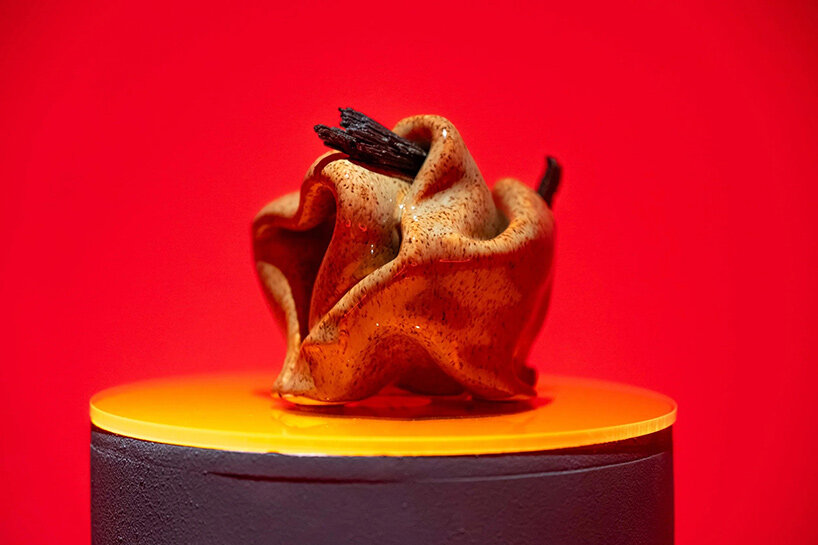

The dream of settling Mars has a blind spot, and Brazilian artist Mari Nagem points straight at it. At New York’s CUE Art, her show The Tropics, The Moon, and Mars put the argument in a room washed with saturated red light, where motorized branches turned slowly beside small ceramic forms. The room looked like another planet, but almost everything in it came from Earth.
Her question is a simple one. We are getting very good at engineering ways to live on distant worlds, yet we keep overlooking the living systems we already have. If we carry the same extractive habits to Mars, why would the result be any different?
Research first, sculpture second
Nagem usually starts from scientific research and works outward into sculpture and digital media. Flora Futura (The Survival Dance) draws on ESECAFLOR, a long-running experiment in the Brazilian Amazon, where researchers divert rainfall from patches of forest to see how trees cope with prolonged drought. In the gallery, bare branches on motorized stands sway against the red light and throw shifting shadows. You can’t tell whether they are adapting or dying, which is exactly the uncertainty the experiment is trying to resolve.
The ceramics keep to the same theme. Folded forms, made by wrapping clay around fragments of mineral, recall the processes of extraction and look like ruins from a future that hasn’t happened yet.
Making data walkable
Other works in the show translate environmental data into something a body can stand inside. 41°C (2025) is a 43-metre painting laid across the ground at the Emílio Goeldi Zoobotanical Park in Belém, made for COP30. Its colors follow the Tefé River, where water temperatures reached 41°C during the severe Amazonian drought of 2023 and contributed to the deaths of hundreds of river dolphins. Nagem built it from satellite imagery and thermal data, so visitors could meet an extreme climate event at their own scale.
The Right to Shade (2026) looks at who gets relief from the sun in Fortaleza. Using satellite imagery and AI-assisted analysis, Nagem and her collaborators mapped trees and buildings across the city and showed how sun exposure differs from one neighborhood to the next. The project began with an interest in cooling architecture, including a new take on the cobogó, the perforated Brazilian brick that filters light. It ended up with something older: the tree canopy, which cools through a biological system no building has matched. The work leaves a pointed question hanging. Why do cities keep inventing artificial fixes while neglecting the living infrastructure they already have?
Songs for birds that are gone
Siren (2024), made with Leandro Lima for SFER IK Museion in Mexico, uses artificial intelligence to imagine the songs of extinct South American birds. The sound comes from nest-shaped ceramic speakers that combine digital fabrication with traditional handcraft. It is an uneasy piece, because the technology can approximate a voice while the animals themselves, and the web of relationships they belonged to, stay lost.
Across these projects, Nagem keeps returning to the gap between what humans can build and what we have actually learned to understand. As plans for lunar and Martian settlements get more detailed, her work turns attention back to the species and landscapes we already share a planet with.
Mari Nagem: The Tropics, The Moon, and Mars was on view at CUE Art, New York, from 11 July to 10 October 2026.