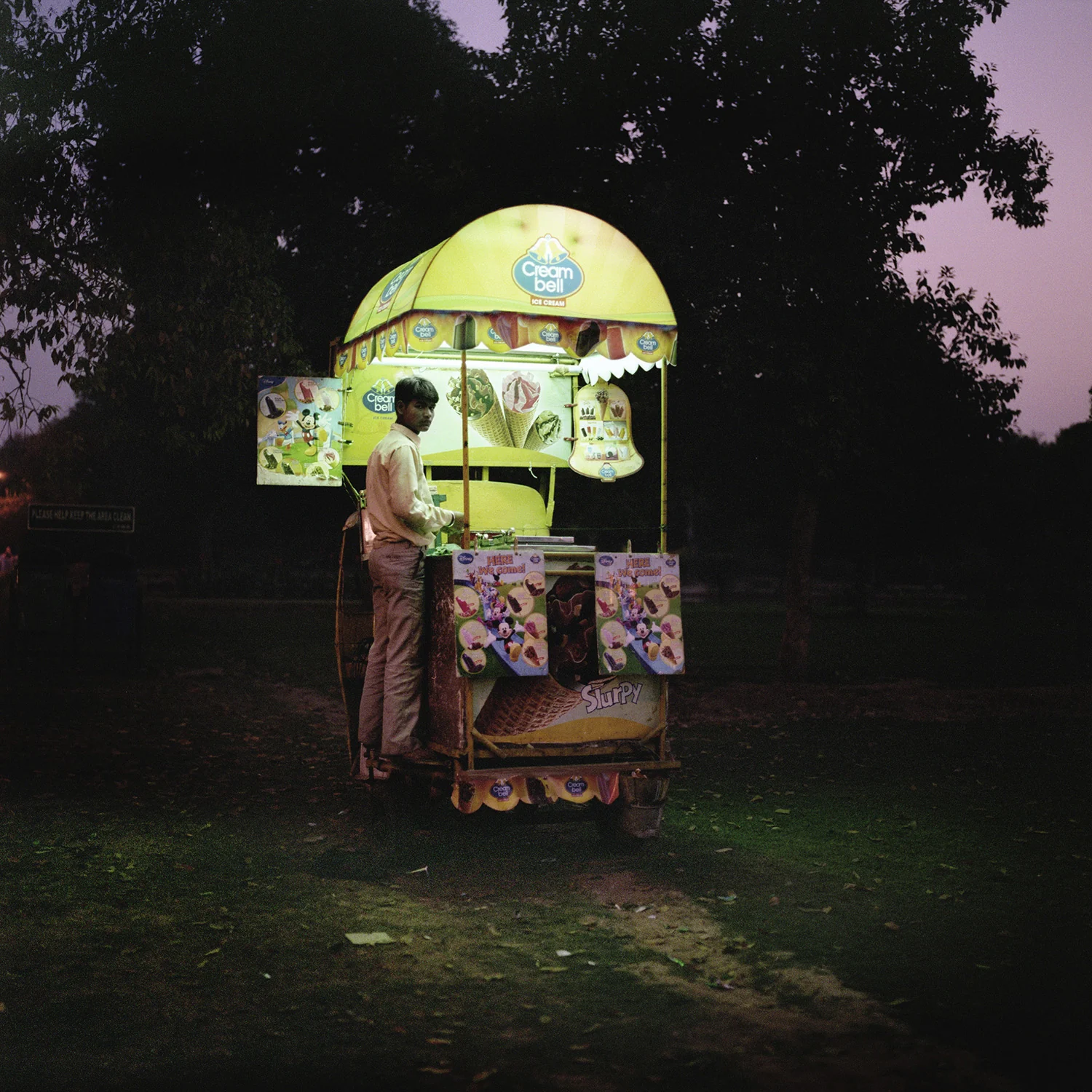

Since 2008, Italian photographer Rocco Rorandelli has been documenting India’s rapid transformation, from expanding megacities and vast construction sites to the communities living on the edges of urban growth. His ongoing photographic project, MY INDIA | GLORY, now arrives in Triggiano, Puglia, where it unfolds through the narrow alleys of the town’s historic centre until January 2027.
Rather than relying on familiar images of India, Rorandelli focuses on the tensions shaping the country’s development. His photographs span Delhi, Mumbai, Jaipur, Punjab and Chandigarh, capturing luxury residential complexes, unfinished buildings, informal settlements and infrastructure projects that continually reshape the landscape. Using a consistent square format and a direct, frontal approach, he records the human and environmental consequences of a country pursuing economic growth at extraordinary speed.
The exhibition’s setting is central to its impact. Instead of presenting the photographs within a conventional gallery, the installation places them on backlit supports along Triggiano’s historic streets. After sunset, the images glow against the warm light falling on the town’s stone façades, transforming the alleys into an unexpected encounter between two very different urban realities.
The contrast becomes even more striking because of the narrow streets. With little room to step back, visitors find themselves standing close to images of seemingly limitless urban expansion. The sprawling outskirts of Indian cities are compressed into intimate Mediterranean spaces, creating a tension between the vastness depicted in the photographs and the physical limits of the streets surrounding them.
Chandigarh, the planned capital of Punjab designed by Le Corbusier in the 1950s, provides one of the project’s most compelling subjects. Rather than focusing on the city’s monumental modernist architecture, Rorandelli turns his attention to its margins: informal dwellings, makeshift entrances to English-language schools and commercial signs that reveal the complexities of everyday life. The photographs expose the gap between the rational order imagined by urban planners and the social realities that inevitably reshape their designs.
Placed within Triggiano’s historic centre, these images create a dialogue between two contrasting forms of urban development. Chandigarh emerged from a unified modernist vision, while the Apulian town grew gradually through centuries of accumulated history. Yet neither offers a simple model of how cities should evolve. Both reveal the tensions between the spaces people inherit, the environments they build and the lives that unfold within them.
By bringing India into the everyday surroundings of a small Italian town, MY INDIA | GLORY also challenges the distance through which the Global South is often viewed. The photographs become more than documents of another country’s transformation: they invite visitors to consider how urban growth, inequality and the changing relationship between people and their environments extend far beyond geographical boundaries.
In Triggiano, India is not presented as an exotic elsewhere. It becomes a presence woven into the streets, prompting a question that lingers after the encounter: are we looking at a distant reality, or at a reflection of our own?