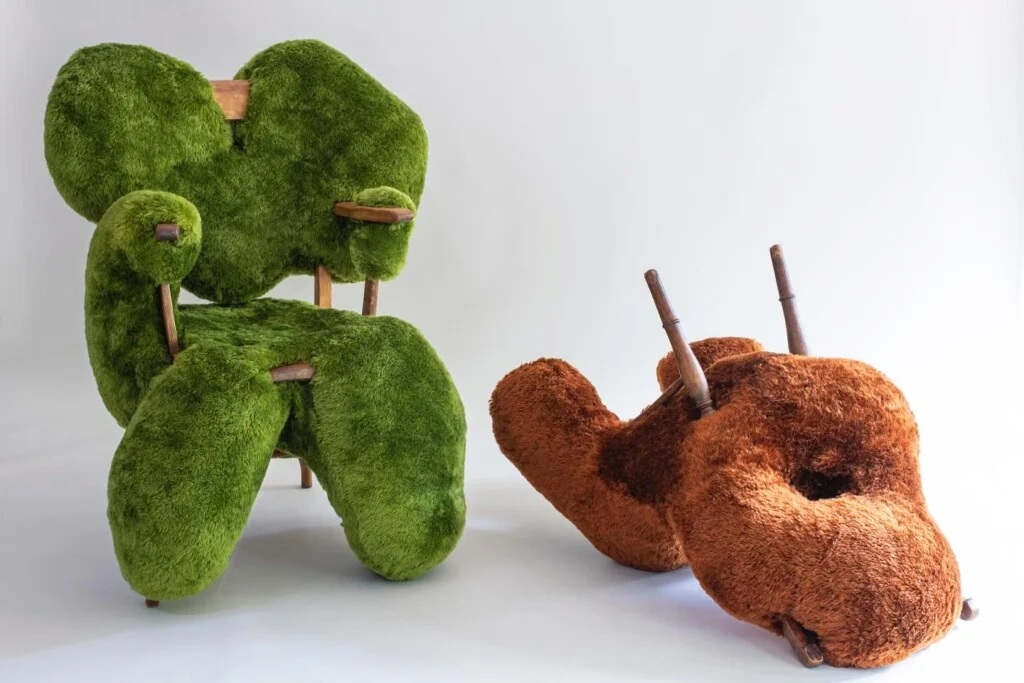

London-based designer Charlotte Kingsnorth reimagines familiar furniture through tactile materials, exaggerated volumes and biomorphic shapes. Her chairs blur the boundaries between design and sculpture, turning everyday objects into curious forms that seem to belong as much to the natural world as to the home.
Rather than simply reupholstering vintage furniture, Kingsnorth alters its structure and appearance until the original object becomes something unexpected. Rigid frames give way to soft, irregular silhouettes; familiar proportions dissolve beneath layers of padding, velvet, mohair and synthetic fur. The result is furniture that appears almost alive — somewhere between an upholstered seat, an abstract sculpture and an imagined creature.
In her Hi!breed series, traditional chair frames become the foundations for sculptural interventions, with voluminous upholstery giving each piece a distinct character. Soft Boulder takes a different approach, transforming a seat into a form resembling a rock covered in fur. The contrast between the apparent solidity of the shape and the softness of its surface challenges conventional ideas about what furniture should look and feel like.

Kingsnorth’s material choices are central to these transformations. Velvet suggests the richness of an organic surface, synthetic fur evokes animal textures, and foam reshapes familiar structures into something less predictable. In Squishy Thonet II, two Thonet chairs are joined and enveloped in biomorphic padding covered in acid-green velvet. Holey Foam Hi!breed Chair, meanwhile, combines silk-covered foam with oversized metal eyelets, bringing together softness and industrial detail.
Yet the designer does not entirely erase the history of the objects she works with. The original structures remain traces of another life, creating a tension between recognition and reinvention. A vintage chair becomes both a point of departure and a material to be questioned: how much can its form change before it ceases to be familiar?
This ambiguity gives Kingsnorth’s work its particular appeal. Her furniture resists the restraint of conventional minimalism, inviting attention through its unusual silhouettes and tactile surfaces. The pieces are designed to be used, but they also ask to be looked at, approached and explored.
In Kingsnorth’s practice, function and imagination are not opposites. A chair can still accommodate the body while suggesting something beyond its everyday purpose. By transforming furniture into almost organic presences, she invites us to reconsider the objects that surround us — and to see how even the most familiar forms can become strange again.