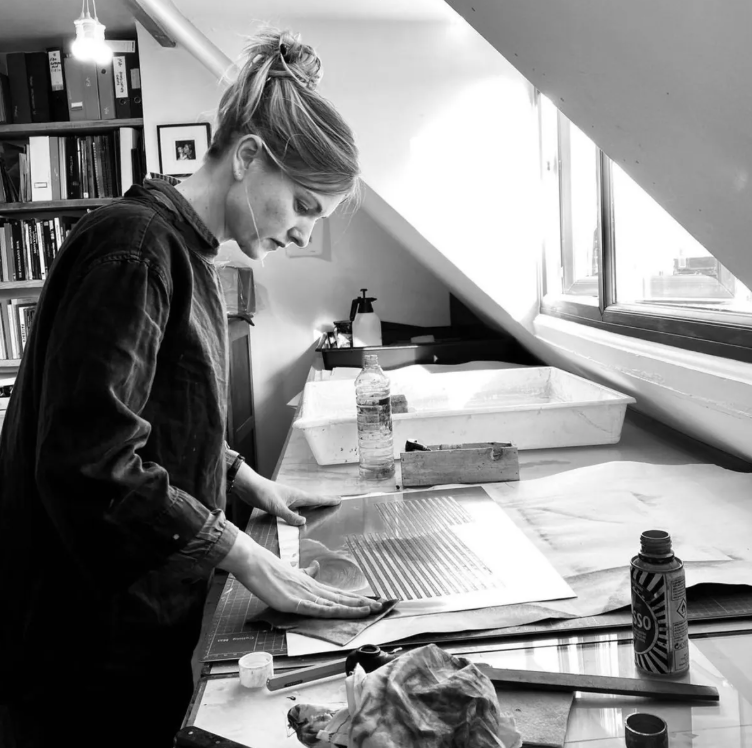

Gillian Garnica’s prints begin with observation but end somewhere far removed from documentation. Working between photography and intaglio printmaking, she reduces images to their essential structures: a dark mass, a fragment of architecture, a geometric rhythm, a carefully measured field of empty paper. What remains is not a record of a particular place, but an image stripped of information until it begins to function as an independent visual object.
This process of reduction is central to Garnica’s practice. Her photographic background is evident in the way she frames and isolates forms, but etching fundamentally changes the nature of what she sees. A photograph can capture detail instantly; an etched image requires translation. The subject passes through the physical processes of biting, inking and printing, and each stage introduces a degree of distance from the original.
Garnica embraces this uncertainty. She has described the “distillation” of an image as one of the most important aspects of her practice, noting that the indirect nature of etching creates a kind of visual “Chinese whisper”. The comparison is precise: the final print retains the identity of the original image while allowing it to shift, lose information and acquire something new.

Her monochrome palette intensifies this transformation. Deep aquatint produces dense, velvety blacks, often set against areas of untouched paper. The contrast is not merely formal. In Garnica’s work, negative space has physical and psychological presence. White areas interrupt the weight of the dark forms, creating pauses within the composition and preventing the image from becoming descriptive.
This relationship between presence and absence connects her work to the Japanese aesthetic of wabi-sabi. Yet Garnica’s engagement with the idea is not decorative. It is embedded in her approach to making: accepting imperfection, allowing materials to retain their character and recognising the value of processes that cannot be completely controlled.
ORDNANCE, selected for the Royal Academy Summer Exhibition, exemplifies this approach. The work takes a structural subject and removes much of the information required to identify it immediately. Architecture becomes pattern; pattern becomes atmosphere. The viewer is left between recognition and abstraction, aware that the image refers to something concrete without being told exactly what that something is.
This ambiguity is one of Garnica’s strongest devices. Her prints do not ask the viewer to decode a narrative. They ask for sustained looking. The longer one stays with the image, the more significant small differences in tone, texture and proportion become.
There is also a deliberate tension between the apparent simplicity of the finished works and the complexity of their production. Etching is slow, technical and materially unpredictable. Garnica’s restrained compositions therefore represent not an absence of information, but a highly controlled decision about what to remove.
In a culture saturated with immediate and highly detailed images, this restraint becomes meaningful. Garnica slows the photographic image down and gives it weight. Her prints demonstrate that reduction can be as expressive as accumulation — and that sometimes an image becomes more powerful precisely when it refuses to tell us everything.