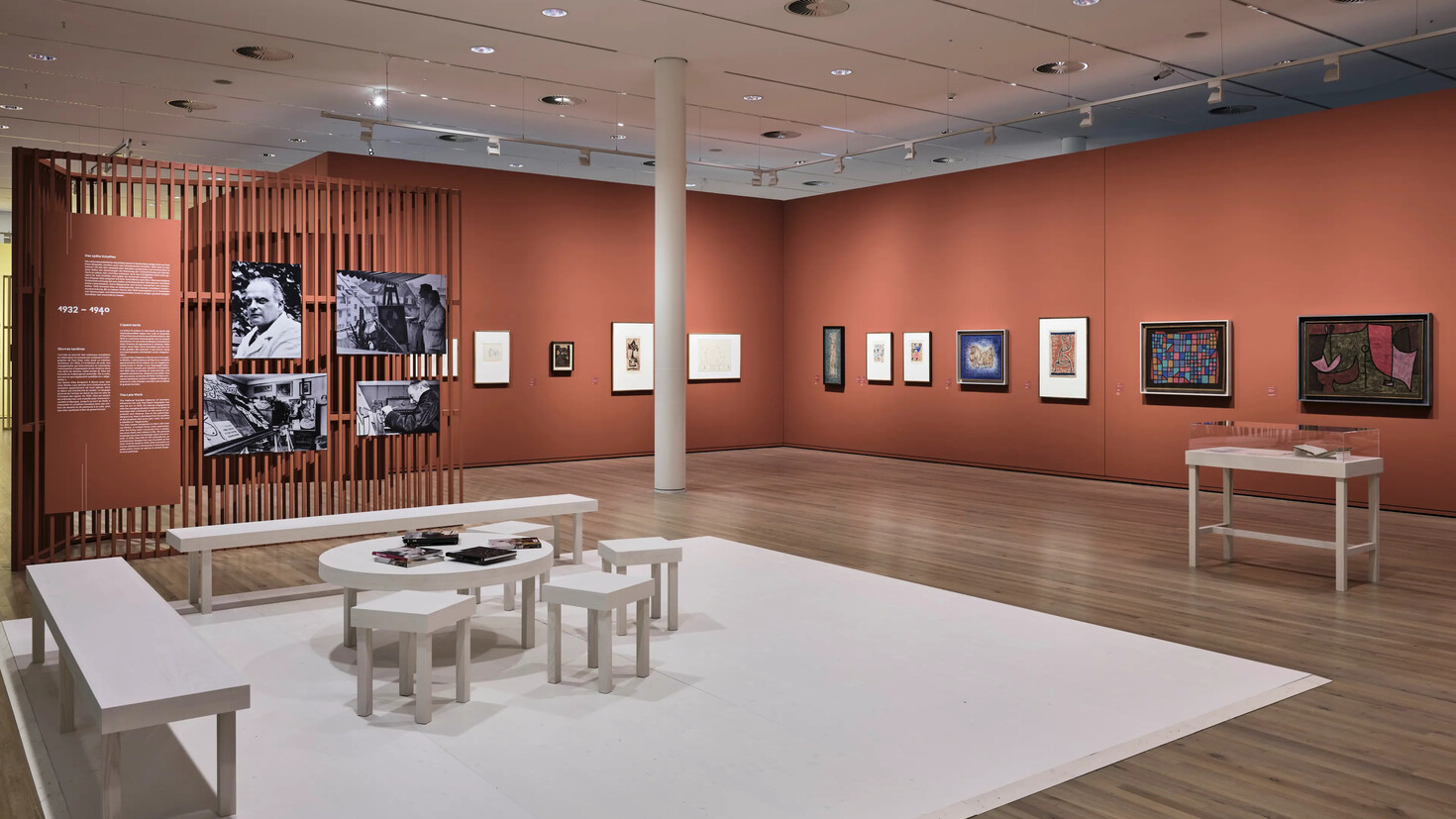

At the Zentrum Paul Klee in Bern, one exhibition has been quietly running since 2023 and won’t close until 2027 — not because it’s stagnant, but because it’s designed to keep changing. Kosmos Klee. The Collection offers a chronological walk through Paul Klee’s artistic life, built from roughly seventy works pulled at a time from a collection that holds around 4,000 pieces total, making it the largest and most significant repository of Klee’s paintings, watercolors, and drawings anywhere in the world.
That rotation isn’t just curatorial variety for its own sake — it’s necessity. Klee worked primarily as a draughtsman, so roughly 80% of the collection consists of works on paper, many made with light-sensitive inks, paints, and materials he was constantly experimenting with technically as well as artistically. Fragile, easily damaged by prolonged light exposure, these pieces simply can’t stay on view indefinitely. They need real periods of rest between exhibitions, which is exactly why no single visit to Kosmos Klee shows quite the same collection twice.
The exhibition organizes itself chronologically, with each decade of Klee’s career marked by its own color scheme — a simple device that lets visitors navigate his development intuitively, from the tightly detailed early work through his gradual pull toward abstraction and color theory, and finally into the pared-down visual language of his final years. Biographical photographs, archival film, and short introductory texts round out the picture, tracing not just what Klee made but who he made it alongside.
That biography is worth knowing on its own terms. Born in 1879 near Bern, Klee spent years torn between music and painting before settling on art, studying in Munich and eventually falling in with the Blaue Reiter circle — Kandinsky, Macke, Münter, Marc — in 1911. A pivotal 1914 trip to Tunisia with Macke and Louis Moilliet deepened his interest in color and abstraction, setting the stage for his decade at the Bauhaus, where Walter Gropius brought him on to teach in 1921. He remained a serious presence in avant-garde circles through the 1920s, exhibiting alongside Ernst, Miró, and Picasso in Paris’s first Surrealist group show, before the rise of the Nazi regime forced him out of his teaching post in 1933 and back to Bern. His art was branded “degenerate” by the Nazis in 1937, with over a hundred of his works confiscated from German museums. Despite worsening health from scleroderma, Klee’s final years were remarkably productive — he made 1,253 works in 1939 alone — before his death in 1940, just days before his long-pending Swiss citizenship application was finally approved.

The exhibition’s “Focus Room” runs alongside the permanent collection, hosting smaller thematic shows built around specific aspects of Klee’s work or unexpected points of connection to other artists and fields. One recent edition, Architecture with Klee: From Mies van der Rohe to Lisbeth Sachs (June–October 2024), traced Klee’s surprisingly deep influence on 20th-century architecture — an angle less discussed than his well-documented impact on music, literature, and philosophy. The show paired Klee’s own theoretical drawings and Bauhaus teaching sketches against the work of architects including Mies van der Rohe, Carlo Scarpa, Lina Bo Bardi, and Aldo Rossi, with particular attention paid to Lisbeth Sachs — one of Switzerland’s first independent female architects — whose 1948 review of a Klee exhibition in the Neue Zürcher Zeitung reportedly still holds up as sharp criticism today.
Kosmos Klee is curated by Fabienne Eggelhofer, with support from the Canton of Bern, the Federal Office of Culture, and the Burgergemeinde Bern. It runs at the Zentrum Paul Klee through October 3, 2027.