
French practice Studio KO has completed the Centre for Contemporary Arts Tashkent (CCA Tashkent), transforming a pair of century-old industrial buildings in Uzbekistan’s capital into a new cultural landmark. Commissioned by Gayane Umerova, chair of the Uzbekistan Art and Culture Development Foundation, the project is built around two ornamental yellow-brick structures designed in 1912 by architect Wilhelm Heinzelmann — one an administration building, the other a tram depot and diesel station that still carries a faint trace of oil in its brickwork.
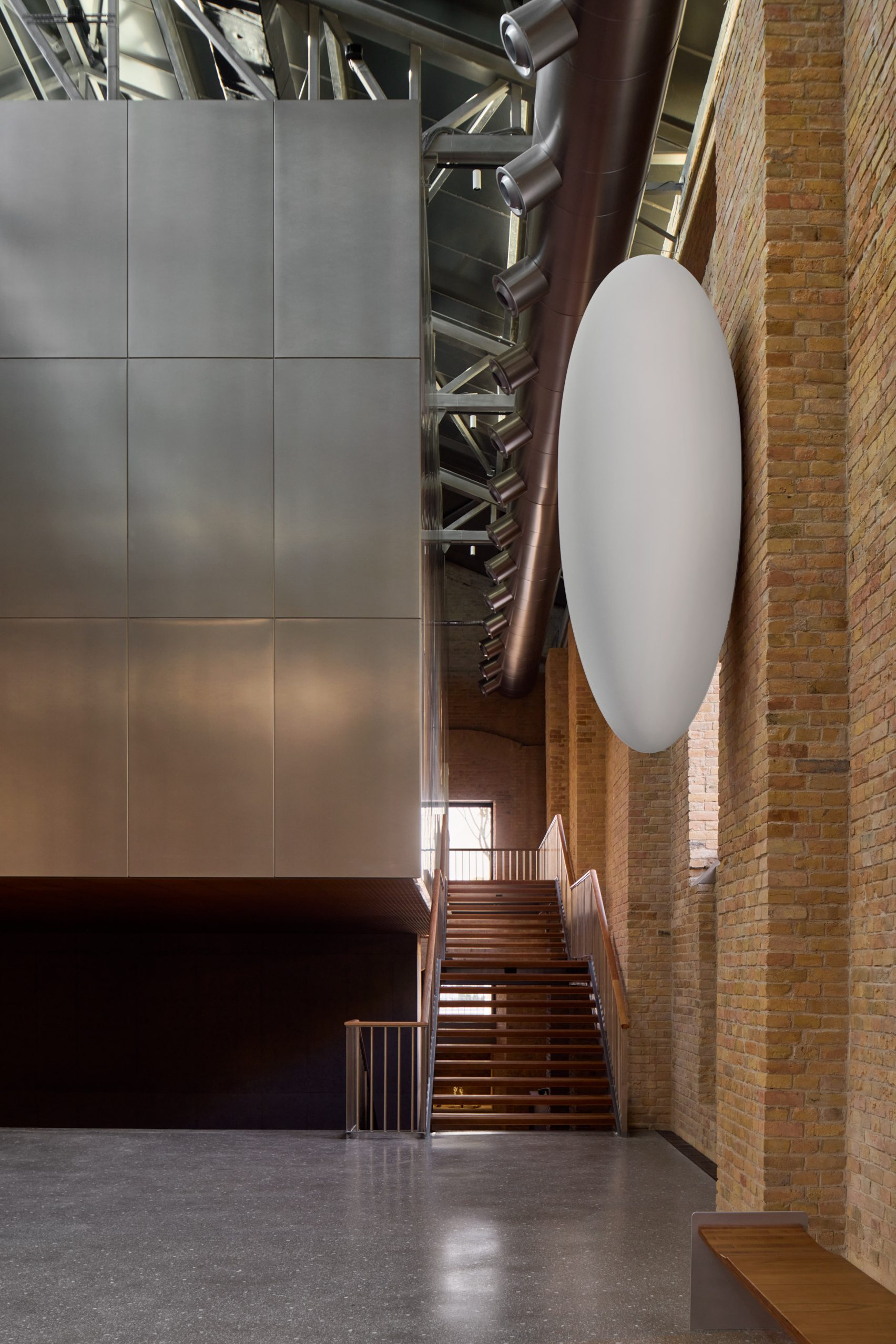
The heart of the project sits inside that former diesel station: a tall, industrial hall lined with high-level windows and the building’s original brick, which Studio KO describes almost reverently. “It was already very monumental, almost like a basilica with its proportions,” director Olivier Marty told Dezeen during a tour of the building. “We remained very faithful to it.” The comparison isn’t just to a cathedral — the team also likens the space to a scaled-down version of the Turbine Hall at Tate Modern.

Visitors enter through the old administration building, now converted into a reception area, gift shop, and staff offices, with a skylit library and a listening room tucked into the top floor. The original shell has been extended with a blocky, self-supporting volume that appears to push out from one corner of the historic structure — clad in coarse gravel typically used locally to mix concrete and finished with a glossy varnish, a deliberate contrast to the brick it interrupts.

From reception, a sculptural helical staircase spirals down into the first gallery — what Marty calls an “anteroom” — before a dark, metal-lined tunnel leads visitors into the basement of the old diesel station. That lower level holds a second gallery alongside bleacher-style seating that doubles as a staircase, running beneath a cubic auditorium suspended overhead. The sequence is designed to build tension: moving from a dark, low-ceilinged passage into the bright, soaring main hall creates a deliberate shift in atmosphere, with exposed technical services overhead reinforcing the space’s industrial character. “This area is interesting as it is where you understand the monumentality of [the main hall],” Marty said. Chief curator Sara Raza added that the comparison to the Turbine Hall was intentional, if scaled down.
Material contrast runs through the whole project — steel panels line the auditorium and tunnel, set against the original brick, while wood detailing and dark, earthy terrazzo (a nod to Soviet-era modernism, according to Marty) add warmth throughout. “The contemporary interventions are designed to be legible as an extreme contrast with the existing fabric of the building,” Marty explained. The building’s large windows carry a purple-tinted filter, visible only from outside.
The architectural journey ends in a large open-air courtyard, framed by sweeping walls finished in the same dark gravel, which houses a restaurant, an adaptable children’s workshop space, and a prayer room. Marty describes the courtyard as a “contemporary version of a traditional mahala” — the courtyard-centered residential neighborhoods typical of Uzbek architecture — designed to feel distinct from the two buildings around it without competing with either. “It was very hard to imagine a courtyard between those two very strong buildings,” he said. “We didn’t want to mimic the bricks, we needed to be honest in the modern edition and to create something that doesn’t compete with it.”
CCA Tashkent has opened with Hikmah, an inaugural exhibition curated by Raza featuring ten artists, alongside a bespoke set of modular metal-and-wood furniture designed by Studio KO. The project joins a wave of major architectural activity in Uzbekistan, including Lina Ghotmeh’s conversion of a historic Bukhara home into the Jadids’ Legacy Museum and Tadao Ando’s National Museum of Uzbekistan in Tashkent. In July, ten of Tashkent’s key modernist buildings were added to UNESCO’s World Heritage list.