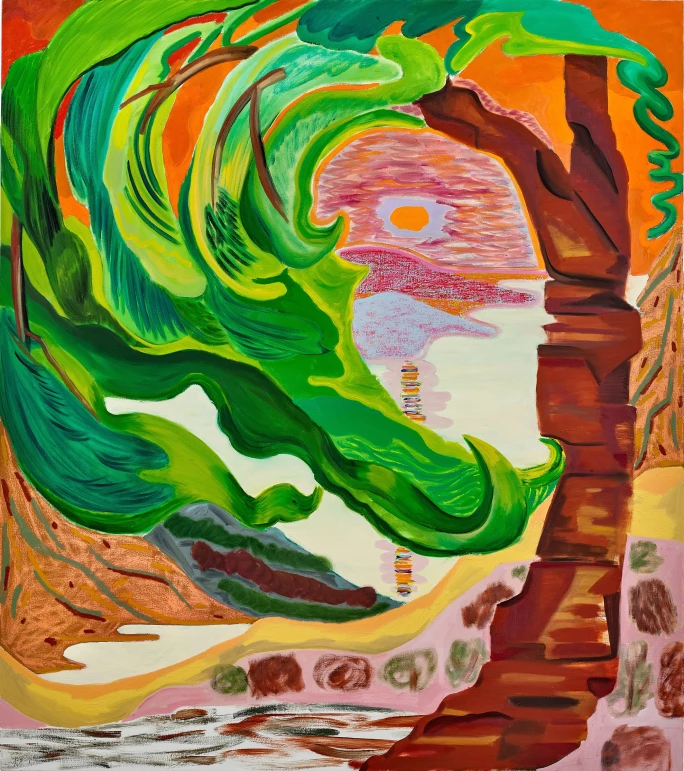

Shara Hughes does not paint landscapes as places to be recognized. She paints them as places to be felt.
Her gardens, trees, mountains, sunsets, moons, and bodies of water are familiar enough to trigger recognition, yet they rarely behave according to the logic of the real world. Trees twist into improbable shapes, horizons tilt, colours become unnaturally intense, and light seems to come from several directions at once. The landscape remains recognizable while becoming psychologically unstable.
This tension is at the centre of Hughes’s work.
Born in Atlanta and now based in New York, Hughes studied at the Rhode Island School of Design, graduating with a BFA in 2004, and later attended the Skowhegan School of Painting and Sculpture. Her breakthrough came relatively early, including her participation in the 2017 Whitney Biennial. Since then, her paintings have entered major museum collections and exhibitions, establishing her as one of the distinctive voices in contemporary American painting.
What makes Hughes’s work immediately recognizable is not a particular subject but the way she handles it. Her brushwork is energetic and deliberately visible. Paint seems to move across the canvas rather than simply describe objects. A tree can become a network of strokes; a patch of grass can turn into a field of competing colours; a sunset can occupy the entire picture like an emotional event.
Her paintings are often described as surreal or dreamlike, but those labels can be limiting. Hughes is less interested in constructing an alternative universe than in showing how unstable our perception of the real one can be.
Take Tipsy (2016). The painting presents a tropical landscape saturated with colour, but its apparent simplicity quickly begins to unravel. A curved palm leaf dominates the foreground while the sky behind it seems almost liquid. Forms overlap without settling into a conventional spatial hierarchy. The image feels cheerful at first, but there is something slightly disorienting about it—as if the landscape has been remembered rather than observed.
That distinction matters.
Hughes does not paint from the premise that a landscape exists independently of the person looking at it. Her paintings suggest that perception is already filtered through memory, mood, fantasy, art history, and visual culture. A sunset is never just a sunset. It can be nostalgic, threatening, romantic, artificial, or absurd.
This is where her relationship with earlier generations of landscape painters becomes interesting. Hughes clearly understands the seductive power of Impressionist colour, but she does not use colour to reproduce optical experience. Instead, she exaggerates it. Colour becomes subjective and expressive.
Her saturated oranges, electric greens, deep blues, and unexpected pinks often push the landscape towards abstraction. Yet the objects remain identifiable. The viewer is constantly moving between two readings: What am I looking at? and Why does it feel like this?
The second question is ultimately more important.
Hughes’s approach also recalls artists such as David Hockney and Charles Burchfield, who questioned the idea that landscape painting should obey naturalistic perspective and consistent light. But Hughes adds a distinctly contemporary psychological dimension. Her landscapes can feel like mental spaces—places where contradictory emotions coexist.
There is often something unsettling beneath their visual pleasure.
A beautiful garden might contain an oddly distorted tree. A peaceful body of water may feel strangely claustrophobic. A glowing sky can appear almost toxic. Hughes uses the seductive qualities of colour to pull the viewer into an image and then quietly destabilizes the experience.
Her paintings therefore resist a simple opposition between beauty and anxiety. Beauty is precisely what allows the tension to enter.
This quality connects Hughes to artists such as Philip Guston, Forrest Bess, and Dana Schutz. The connection is not primarily stylistic. What they share is a willingness to let painting become psychologically charged without abandoning figuration altogether. Hughes takes recognizable imagery and pushes it until it begins to reveal something less stable underneath.
At the same time, humour plays an important role in her work. Her trees can look awkward, her compositions slightly tipsy, her natural forms almost cartoonish. There is a sense that the artist enjoys allowing painting to misbehave.
That sense of play prevents the work from becoming overly solemn. Hughes does not ask the landscape to carry a grand philosophical meaning. Instead, she treats painting as a space where visual rules can be bent, contradicted, and reinvented.
This freedom is especially apparent in her treatment of space. Traditional landscape painting depends on the organization of depth: foreground, middle ground, horizon. Hughes often disrupts this hierarchy. A leaf may become as important as a mountain; a distant sky may feel physically close; a tree can flatten into a decorative pattern.
The result is a landscape that behaves more like a painting than a window.
This is one of the reasons her work is so compelling in an age saturated with photographic images. Hughes does not compete with photography in terms of accuracy. She reminds us that painting can offer something photography cannot: a visual world that is explicitly shaped by the movements, decisions, impulses, and contradictions of the painter.
Her brushwork remains part of the subject.
You can see the hand behind the image. Paint is not hidden beneath the illusion of a landscape; it constantly threatens to break that illusion. The painting asks to be looked at both as an image of a place and as an accumulation of physical marks.
That duality gives Hughes’s work its particular energy. Her paintings are simultaneously landscapes and abstractions, images and objects, jokes and serious investigations into perception.
The natural world in Hughes’s paintings is therefore never entirely natural. It has been filtered through art history, popular imagery, personal memory, and the emotional logic of painting itself.
Perhaps this is why her landscapes feel strangely familiar. They resemble places we know from paintings, photographs, films, dreams, and memories rather than places we have necessarily visited.
Hughes does not ask us to believe in her landscapes.
She asks us to enter them.
And once inside, the rules of the real world become wonderfully unreliable.