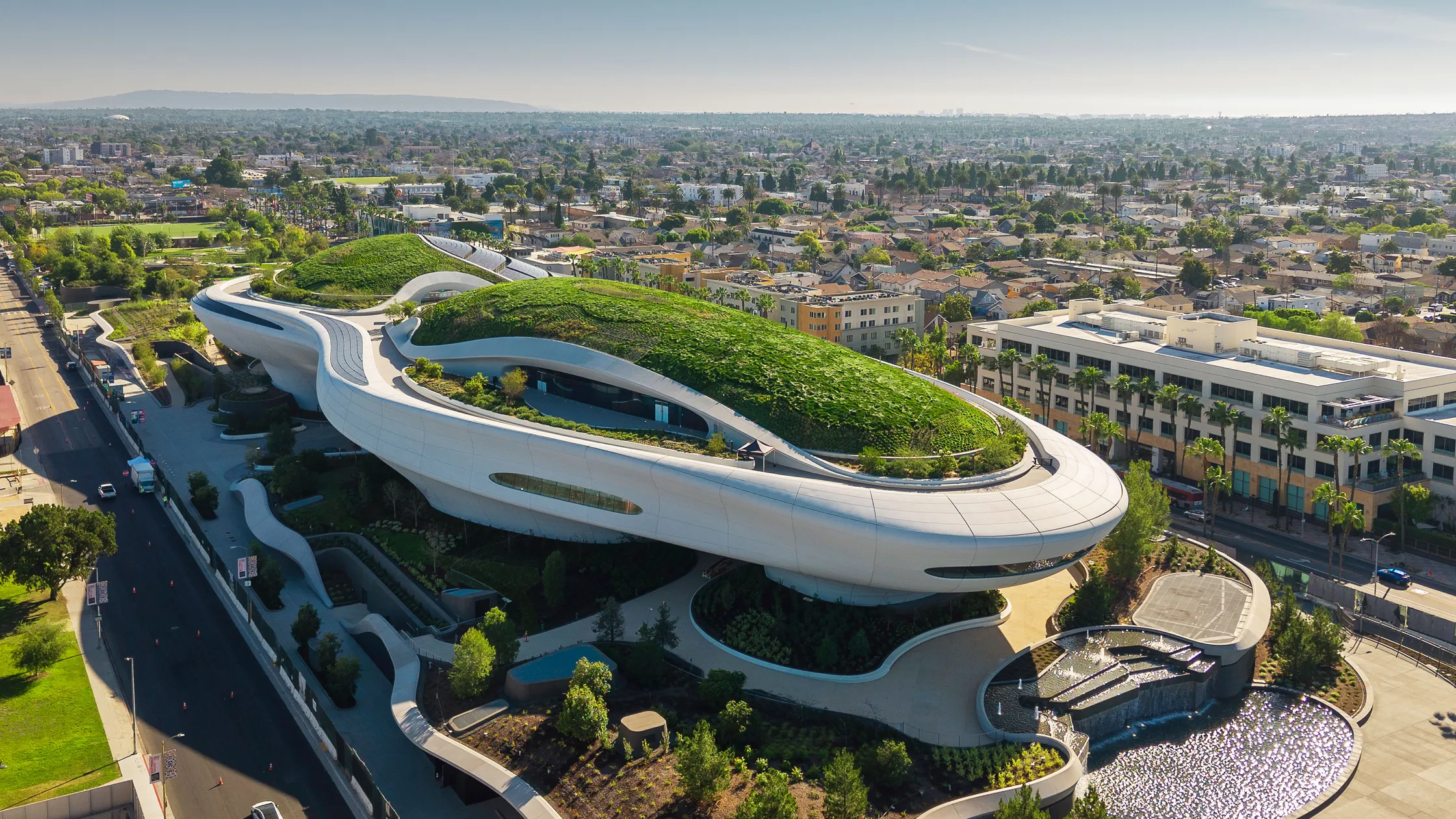

The Lucas Museum of Narrative Art is difficult to read as a conventional museum. Its architecture already feels like a statement before you encounter the collection. Designed by Ma Yansong of MAD, the building rises from Los Angeles’s Exposition Park as a huge curved form, lifted above the ground and covered with vegetation. It looks futuristic, but its ambition is surprisingly simple: to make people curious enough to come inside.
That idea comes directly from George Lucas and Mellody Hobson’s concept of narrative art. The museum does not draw a strict line between “high” and “popular” culture. Its collection brings together religious and historical imagery, illustration, comics, photography, film, and works by artists such as Norman Rockwell and R. Crumb, alongside objects connected to Lucas’s own cinematic universe. The point is not that all these things are identical. It is that they share a fundamental function: they tell stories and shape the way people imagine the world.
The architecture follows the same principle.
Ma Yansong avoids the monumental language traditionally associated with museums. There is no heavy stone façade or ceremonial staircase. Instead, the building seems to hover. More than 1,500 curved fiberglass-reinforced polymer panels create its continuous skin, while enormous cantilevers push the structure outward. Technically, the building is extremely complex; visually, however, it is meant to feel almost effortless.
That contrast is important. The museum is engineered like a major piece of infrastructure but experienced almost like a fantasy object. It is closer to the logic of cinema than to the classical museum tradition. You do not understand it all at once. You move around it, discover openings, enter beneath the structure, look upward, and gradually understand how its different parts connect.
The landscape plays an equally important role. Studio-MLA designed the surrounding gardens as an extension of the museum rather than as a decorative setting. The terrain rises and folds around the building, incorporating gardens, an amphitheater, sculptures, and water. The roof continues this idea, becoming an artificial landscape of trees, plants, and solar panels.
This makes the museum unusually porous. The distinction between building and park is deliberately weakened. You can experience the institution from outside without necessarily entering it. The ground level becomes a public space rather than simply an entrance zone.
For a museum whose stated ambition is accessibility, this is a smart architectural decision. The building does not ask the visitor to behave like a museum visitor from the first moment. It offers a place to walk, gather, look, sit, and explore.
Inside, the same language continues. The architecture is dominated by curves: rounded elevator cabins, vaulted spaces, glass tubes, and soft transitions between rooms. There are few conventional right angles. The effect is almost bodily. The building seems to guide movement rather than simply accommodate it.
This is where the connection to narrative becomes particularly convincing. A narrative is experienced sequentially. One image leads to another; one scene changes the meaning of the previous one. The Lucas Museum works in a similar way. Its architecture creates a sequence of encounters rather than a single monumental interior.

The museum is also interesting because of the tension between its populist mission and its extraordinary level of technical and financial investment. This is not an informal cultural space. It is an ambitious, highly engineered institution created by two exceptionally wealthy founders. Its democratic rhetoric therefore comes with an obvious contradiction: how can an enormous private museum, built at considerable expense, challenge cultural elitism?
The answer is not completely resolved by the architecture. But the building does make a serious attempt to lower the psychological threshold of the museum. It replaces intimidation with spectacle and expertise with curiosity. You do not need to know art history to appreciate the building. You do not need specialist knowledge to understand why a familiar image, object, or story might matter.
This is also why the inclusion of popular culture is more significant than it may initially appear. For decades, museums and academic institutions have tended to separate canonical art from commercial illustration, comics, film, and mass imagery. The Lucas Museum deliberately complicates that hierarchy.
Its question is not whether a comic book belongs in the same category as a Renaissance painting. Rather, it asks why we have historically assigned such different cultural value to images that can perform similar functions: telling stories, expressing beliefs, constructing identities, and transmitting collective memory.
The museum therefore operates as a kind of alternative art-history machine. Instead of organizing culture exclusively around periods, movements, and canonical artists, it can be understood through the human desire to make images and tell stories.
That approach is particularly fitting for Los Angeles, a city whose cultural identity has been profoundly shaped by cinema and visual entertainment. The Lucas Museum does not attempt to separate Hollywood from the history of art. It puts them into conversation.
At its best, the building does something similar. It does not illustrate the museum’s concept literally; it translates it into an experience. Its floating structure, planted roof, curved circulation, and open relationship with the park create a sense of movement and transformation. The architecture feels less like a container for objects than a setting for encounters.
There is, however, a danger in an architecture this spectacular. When the building itself becomes such a strong visual presence, the institution has to work hard to prevent the architecture from becoming the main attraction. The museum’s success will ultimately depend on whether the collection can hold its own against the building’s powerful image.
But this tension is also part of what makes the project interesting. The Lucas Museum is not pretending to be neutral. It openly embraces spectacle, emotion, fantasy, and popular appeal. In that sense, its architecture is unusually honest about the kind of cultural experience it wants to create.
George Lucas has reduced the project’s ambition to two words: “Create wonder.” That may sound simple, but it describes the museum remarkably well. Wonder here is not just visual amazement. It is the impulse to ask what something is, why it exists, and what story it might contain.
The Lucas Museum is therefore best understood not simply as a new museum building, but as an experiment in cultural accessibility. Its architecture tries to make the institution feel less like a temple of knowledge and more like a place of discovery.
Whether that experiment succeeds will depend on what happens once the initial spectacle wears off. But as an architectural proposition, the museum is clear about its position: culture does not have to begin with expertise. It can begin with curiosity.