
Music festivals rarely become cultural milestones. Most simply reflect the spirit of their era. Others redefine it. Daisy Chain Fields, the new festival created by Olivia Rodrigo, seems determined to belong to the latter category. Behind its impressive lineup lies a carefully considered artistic statement—one that reconnects contemporary pop culture with a legacy that transformed the music industry nearly thirty years ago.
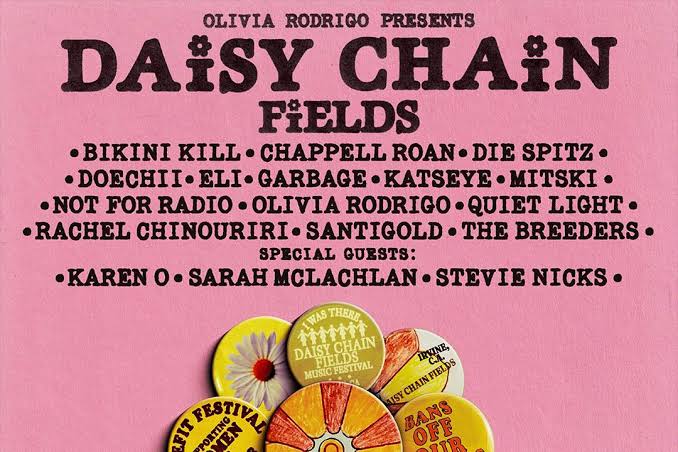
Only weeks after releasing her third studio album, You Seem Pretty Sad for a Girl So in Love, Rodrigo revealed plans for a one-day event taking place on August 29 at Great Park in Irvine, California. The concept is intentionally focused: an entirely female lineup, with every ticket sold contributing directly to organizations supporting women’s health, reproductive rights, maternal care, and Indigenous communities.
The roster itself reads like a dialogue between generations rather than a conventional festival bill. Alongside Rodrigo will perform Chappell Roan, Mitski, Doechii, KATSEYE, Rachel Chinouriri, Eli, as well as influential alternative acts Garbage, Bikini Kill, and The Breeders. The inclusion of Stevie Nicks, Karen O, and especially Sarah McLachlan transforms the festival into something far more symbolic than a showcase of popular artists.
McLachlan’s appearance is impossible to separate from history. In the late 1990s, she launched Lilith Fair, a touring festival that challenged one of the music industry’s most persistent assumptions—that women could not successfully headline major festivals together. Rather than simply creating another concert series, Lilith Fair reshaped expectations, proving that audiences were eager for diversity, artistic collaboration, and female leadership on stage.
What makes Daisy Chain Fields particularly compelling is that it does not attempt to recreate Lilith Fair through nostalgia. Instead, it translates the original philosophy into the cultural language of the 2020s. Today’s generation of artists is no longer asking for permission to occupy space; they are redefining what that space should look like.
This is reflected not only in the lineup but also in the festival’s social mission. Rodrigo has committed 100 percent of ticket revenue to charitable organizations, ensuring that the event extends beyond entertainment into meaningful civic engagement. In doing so, music becomes both performance and participation, reinforcing the idea that festivals can serve communities as well as audiences.
From an art historical perspective, Daisy Chain Fields represents an evolution rather than a revival. Cultural movements rarely survive through exact repetition. They endure because each generation interprets foundational ideas according to its own historical moment. Lilith Fair emerged as a response to institutional barriers within the music industry. Daisy Chain Fields arrives in an era where representation has expanded, yet questions of equality, visibility, and collective responsibility remain central.
Rodrigo herself has often spoken about the responsibility she feels toward the young women who attend her concerts. That perspective places Daisy Chain Fields within a broader artistic tradition in which performers are not merely entertainers but cultural participants capable of shaping values and public conversations.
Whether the festival becomes an annual institution remains to be seen. Yet its significance already extends beyond a single day of performances. Daisy Chain Fields suggests that the most influential festivals are not defined solely by their headliners but by the ideas they leave behind. In that sense, Olivia Rodrigo is not simply honoring the legacy of Lilith Fair—she is giving it a contemporary form, one that speaks to a new generation while preserving the original belief that music can be a catalyst for community, solidarity, and cultural change.