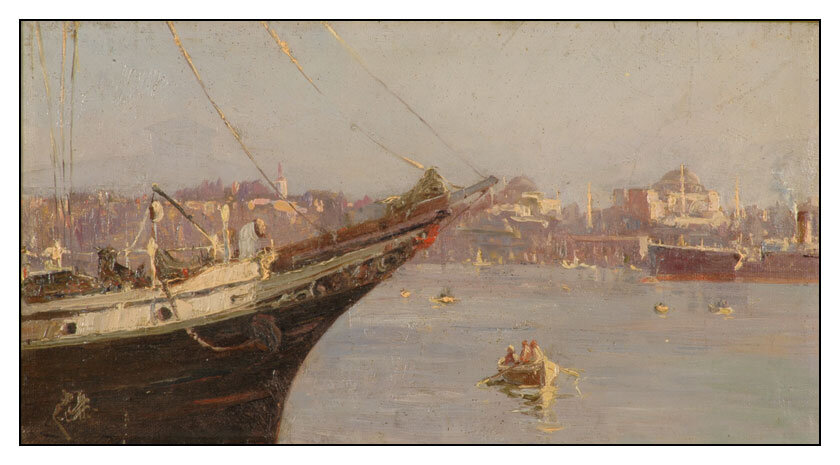
From Ottoman masters to contemporary pioneers: the painters who defined Turkish art
Turkey has always been a meeting point of cultures. Located between Europe and Asia, the country has absorbed influences from Greek, Roman, Byzantine, Ottoman, and Western artistic traditions. This unique cultural landscape created a rich environment for the development of visual art over centuries.
Istanbul, formerly known as Byzantium and Constantinople, became one of the world’s most important artistic centers. As the capital of the Byzantine Empire and later the Ottoman Empire, the city attracted architects, painters, craftsmen, and intellectuals from across the region.
One of the most influential periods in Turkish art history came during the 16th century under the rule of Ottoman Sultan Suleiman the Magnificent. However, many of the artists who shaped modern Turkish painting emerged during the 19th century, when the Ottoman Empire began embracing European artistic ideas.
This list highlights eight of the most important Turkish artists, from late Ottoman painters who introduced Western techniques to modern creators who brought Turkish art into the international contemporary scene.
1. Ferik Ibrahim Pasha (1815–1891)

Ferik Ibrahim Pasha is considered one of the earliest Turkish painters to successfully incorporate Western artistic approaches into Ottoman painting.
After graduating from an art academy in Istanbul in 1835, he traveled through Europe to develop his skills. Although details about his journey remain limited, historians believe he visited Vienna and possibly London, where he encountered European painting traditions.
After returning to Turkey, Ibrahim Pasha worked at the court of Sultan Abdulmejid I. His artistic production focused mainly on landscapes and still-life paintings, genres that were becoming increasingly popular through European influence.
Although he is not the most widely recognized Turkish artist today, his contribution was essential in introducing new methods and perspectives to Ottoman painting.
2. Osman Hamdi Bey (1842–1910)

Osman Hamdi Bey remains one of the most influential figures in Turkish art history. A painter, archaeologist, intellectual, and cultural reformer, he played a major role in modernizing the country’s artistic institutions.
He founded the Istanbul Archaeological Museum and helped establish the Istanbul Academy of Fine Arts, creating foundations for modern art education in Turkey.
Like many Ottoman artists of his generation, Hamdi Bey traveled extensively in Western Europe. In 1867, he presented three paintings at the Paris World Exhibition.
His most famous work, “The Tortoise Trainer” (1906), became one of the most valuable Turkish paintings ever sold, reaching approximately $3.5 million at auction in 2004.
3. Hoca Ali Riza (1858–1930)

Hoca Ali Riza was a Turkish painter and educator best known for his atmospheric landscapes and architectural scenes.
Combining his artistic career with teaching, he influenced generations of Turkish artists through his work at the Istanbul Academy of Fine Arts and other institutions.
His paintings often captured quiet streets, historic buildings, and natural landscapes with an impressionistic sensitivity. Numerous exhibitions dedicated to his work have been organized throughout Turkey, confirming his lasting importance in national art history.
4. Şeker Ahmed Pasha (1841–1907)

Born Ahmed Ali Pasha, he became widely known as Şeker Ahmed Pasha — a nickname meaning “Sugar Ahmed,” given because of his gentle personality and pleasant character.
His path to becoming an artist was unusual. He initially studied medicine and later joined the military before discovering his passion for painting during his education at a military academy.
In the 1870s, Sultan Abdulaziz sent him to Paris, where he developed his artistic skills and became familiar with European painting traditions.
His works, especially landscapes and still lifes, helped introduce new approaches to Turkish painting during the late Ottoman period.
5. Halil Pasha (1857–1939)

Halil Pasha was one of the first Turkish artists to popularize impressionism in Turkey.
Originally trained at a military engineering school, he moved to Paris in the early 1880s, where he studied under French academic painter Jean-Léon Gérôme.
During his eight years in France, Halil Pasha developed a distinctive style influenced by European impressionism. In 1889, he received a medal at the Paris World Exhibition, strengthening his international reputation.
Later in life, he became an influential art educator, sharing his knowledge with younger generations of Turkish painters.
6. Fahrelnissa Zeid (1901–1991)

Fahrelnissa Zeid was one of the most important Turkish female artists of the 20th century and a pioneer of abstract painting.
Born during a period of rapid modernization in Turkey, she showed artistic talent from an early age and became one of the first Turkish women to attend an art academy.
After discovering European art during her travels, Zeid developed a unique style combining abstraction, geometric structures, and vibrant compositions.
She became part of international avant-garde circles, living and working between Istanbul, Paris, and other major cultural centers. Her monumental abstract paintings remain among the most significant examples of modern Turkish art.
7. Abidin Dino (1913–1993)

Abidin Dino was a painter, writer, filmmaker, and one of the most versatile figures in Turkish modernism.
Born in Istanbul, he spent much of his childhood in Switzerland and France, where he was exposed to European artistic movements from an early age.
In the late 1930s, Dino received an important commission to design the Turkish Pavilion at the 1939 World Exhibition in New York.
He later lived primarily in Paris, where he became connected with leading international artists, including Pablo Picasso. Throughout his career, Dino supported younger Turkish artists and helped strengthen cultural connections between Turkey and Europe.
8. Bedri Baykam (born 1957)

Bedri Baykam is one of the most recognized contemporary Turkish artists and a leading figure in the country’s neo-expressionist movement.
Born in Ankara, he received an international education, studying at the Sorbonne in Paris and the California College of Arts and Crafts in Oakland, California.
Beyond painting, Baykam is also a writer and publisher who has authored eighteen books, including several dedicated to art theory and criticism.
Known for his bold personality and experimental approach, Baykam has played an important role in bringing contemporary Turkish art into global discussions.