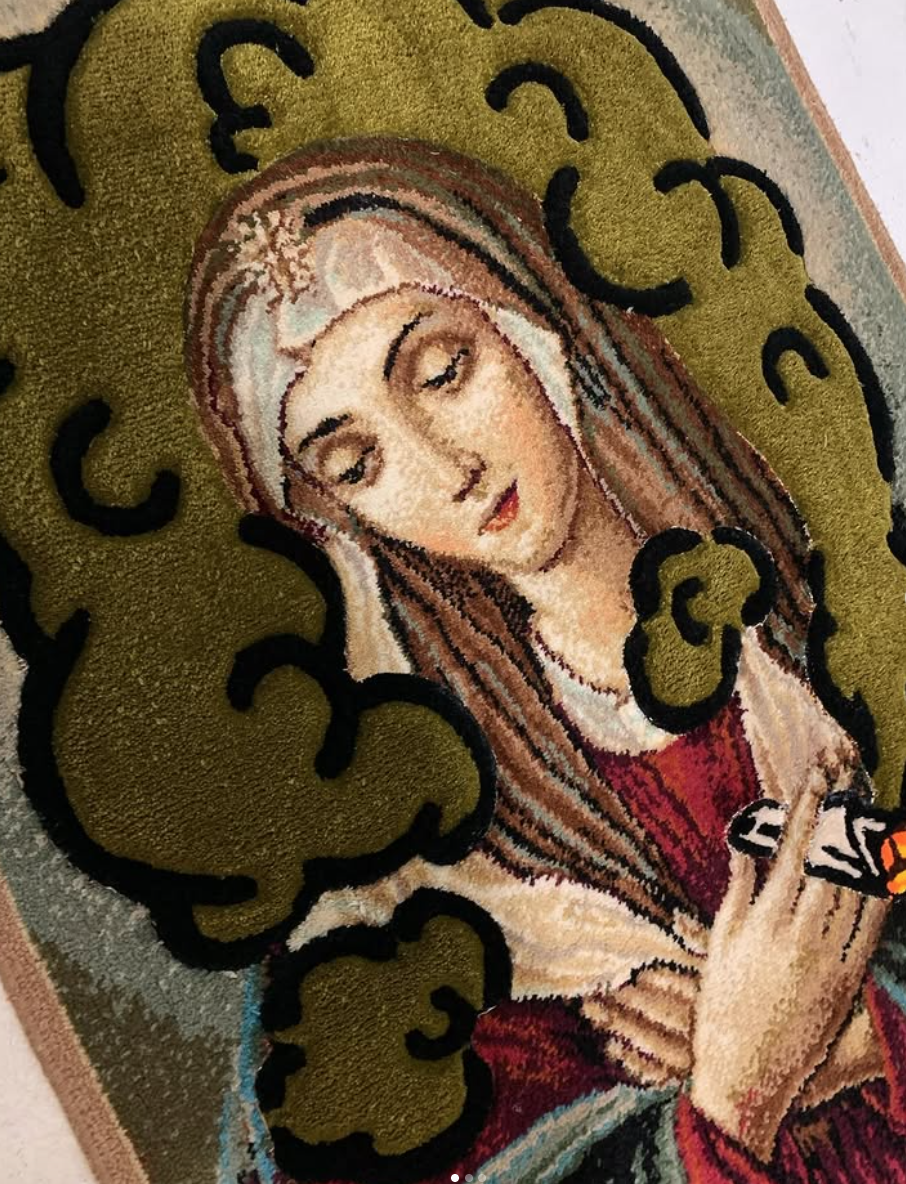


For decades, Soviet carpets were everywhere: on apartment floors, bedroom walls, and in the memories of millions of people across the former USSR. Their bright geometric patterns, floral motifs, and surreal landscapes became part of everyday life — a visual language absorbed almost unconsciously from childhood.
Once dismissed as outdated domestic decoration, these carpets are now returning to contemporary interiors. A symbol of nostalgia and kitsch has become a source of inspiration for designers, artists, and collectors.
Belarusian artist Ilya Kovarny is among those redefining their cultural value. By combining traditional Soviet carpets with contemporary tufting techniques, he transforms forgotten household objects into unique art pieces that connect personal memories, cultural identity, and modern design.
“These patterns are understood on a DNA level”
Kovarny’s passion for carpets is impossible to miss. His Minsk apartment resembles a small contemporary art installation: traditional carpet motifs appear on floors, walls, clothing, and everyday objects. He also collects books about carpet design and Soviet visual culture.
His fascination began in childhood, surrounded by the typical interiors of Soviet and post-Soviet homes.
“Carpets were everywhere — on the floor and on the walls. The jokes about staring at carpet patterns for hours were real for me. The carpet above my bed was one of my main childhood distractions,” he explains.
However, his artistic journey did not begin immediately. Kovarny studied ceramics and traditional Russian decorative painting at the Mir Art College, but later worked in completely different fields, including logistics, bartending, surveying, and tire repair.
Eventually, he moved into video editing and became involved in podcast production. While this work remains his main source of income, he always felt drawn to creating physical objects.
“I enjoy things made by human hands. Objects make ideas tangible,” he says.
The birth of “RECarpet”: giving Soviet textiles a second life
Three years ago, Kovarny discovered tufting — a technique where yarn is inserted into fabric using a specialized tufting gun. The method gained popularity worldwide, but he approached it from a different perspective.
Instead of creating entirely new carpets, he began combining contemporary designs with authentic Soviet pieces.
This concept became “RECarpet” — a project focused on restoring and transforming old carpets into functional artworks.
For Kovarny, Soviet carpets are more than decorative objects.
“An old patterned carpet is about nostalgia. It is a whole cultural language that anyone from the post-Soviet world understands almost instinctively,” he says.
Many Soviet carpets today are considered worthless. People often give them away or throw them out, despite their durability and craftsmanship.
Kovarny believes these objects deserve a different future.
Modern imitations may look similar, but many are simply printed fabrics without the texture, materials, or craftsmanship of traditional woven carpets.
From forgotten household objects to contemporary art
Creating a RECarpet piece requires both technical skill and artistic sensitivity. Kovarny designs each composition himself, whether it is a personal artwork, a commissioned piece, or a brand collaboration.
The process begins with developing the concept and transferring the design onto fabric using a projector. The image must be mirrored correctly before tufting begins — a common mistake among beginners.
The artist then uses a tufting gun to create the new elements, carefully integrating them into the original carpet structure.
The most challenging part is achieving harmony between the old and new sections.
A Soviet carpet already has its own visual identity, colors, and history. Adding a contemporary image without destroying its authenticity requires precision.
“It is not just decoration. The old carpet already has a story. The goal is to continue that story, not erase it,” Kovarny explains.
His first customized carpet, featuring a woman riding a tiger, took two months to complete. Today, similar works usually require three to four weeks, including concept development and production.
The unexpected return of Soviet aesthetics
The revival of Soviet carpets reflects a wider cultural shift. Objects once associated with outdated interiors are being reconsidered by younger generations.
According to Kovarny, consumer culture played a major role in pushing traditional carpets out of fashion.
“People are constantly encouraged to buy something new. Old objects automatically become ‘obsolete,’ even when they are better made,” he says.
For him, the appeal lies precisely in their imperfections and history.
A vintage carpet is not just a design element — it carries traces of previous owners, family memories, and a specific era.
Collecting stories behind forgotten carpets
Kovarny searches for carpets through online marketplaces and second-hand platforms. Looking for new pieces has become part of his daily routine.
The most expensive carpet he purchased cost around $90 and came with a unique history: it had reportedly been brought from East Germany after the fall of the Berlin Wall.
Usually, however, sellers do not attach much emotional value to these objects.
“The best future many unwanted carpets can hope for is ending up on the floor of a hookah lounge,” he jokes.
His mission is to change that perception by turning neglected household items into collectible artworks.
Collaborations, collectors, and recognition
Today, Kovarny works as an independent artist, creating pieces for private collectors, brands, and cultural projects.
His clients include fashion labels, tattoo studios, and creative companies. One notable collaboration involved creating a carpet inspired by the post-Soviet aesthetic of jewelry brand Kate Snap, featuring chains and barbed wire motifs.
Another project combined a Soviet carpet design with a corporate logo and a “Star Wars” theme, incorporating the character Yoda into the composition.
His work gained wider attention after Russian designer and media personality Artemy Lebedev purchased one of his carpets.
Lebedev discovered Kovarny’s work after the artist contacted him directly. Instead of commissioning a new design, he chose an existing piece.
The carpet was sold for approximately $1,000 — a price that reflects Kovarny’s positioning of his works as collectible art rather than simple interior decoration.
Beyond business: the future of carpet art
Despite growing recognition, Kovarny does not want to turn his practice into a large-scale commercial production.
For him, the value lies in remaining an independent artist whose personal vision attracts collaborations.
“I like the idea of being a successful artist — someone whose ideas and perspective naturally bring opportunities,” he says.
His long-term dream is simple: for people to bring him their old family carpets so he can transform them into something new.
“I would love people to bring me their carpets, and I would give them another life. There is something beautiful about connecting generations and different periods of time.”
For Kovarny, carpets are not merely decorative objects. They represent memory, identity, craftsmanship, and the relationship between past and present.
In an era dominated by mass production, his work offers a different approach: preserving history by redesigning it.