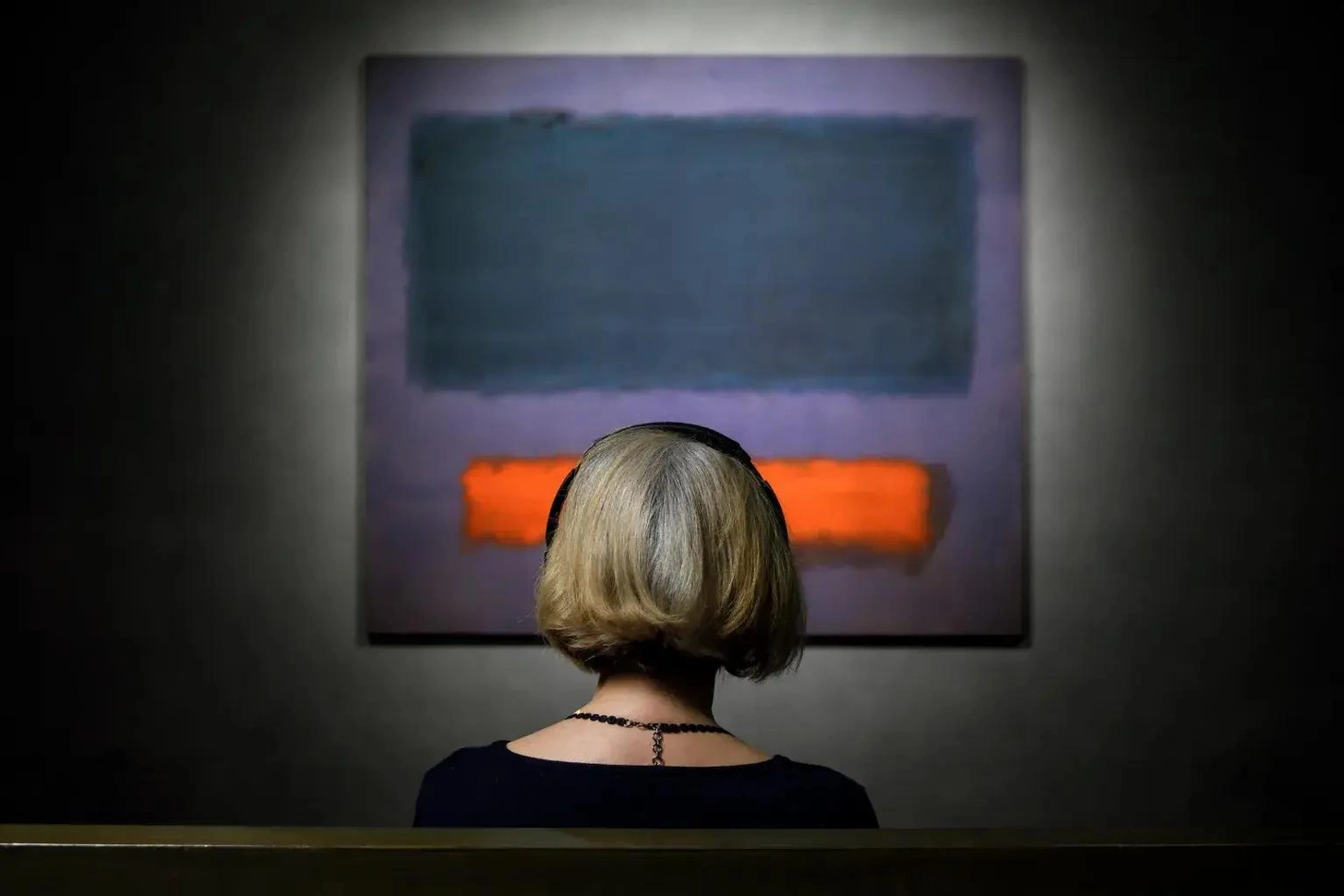

Source: Museum Boijmans Van Beuningen
One of the crown jewels in the collection of Museum Boijmans Van Beuningen in Rotterdam has sustained damage: Mark Rothko’s Grey, Orange on Maroon, No. 8, a canvas valued at roughly €50 million.
According to the museum, the incident happened during what officials are calling a lapse in supervision — a young visitor scratched the lower portion of the painting, leaving faint marks on its unvarnished surface. Small as the damage may sound, restoring a Rothko is anything but simple. His paintings famously carry no protective varnish layer, and their delicate, atmospheric color transitions mean even the slightest disruption becomes visually significant. “Even a minor scratch can completely change how the entire painting reads,” explains Sophie Macalauc, head of restoration at the Fine Art Restoration Company. “Rothko worked with incredibly complex mixtures of pigment, binders, and resin — his surfaces just aren’t built to withstand outside contact well.” Without a protective coating, the canvas is left especially exposed to the environment around it. Grey, Orange on Maroon, No. 8 is considered a standout example of Rothko’s color-field period, defined by large, saturated planes of color with no hard edges.
This isn’t the first time a Rothko has fallen victim to accident or vandalism. In 2012, a visitor at Tate in London deliberately defaced another of his works, Black on Maroon — a restoration that ultimately cost £200,000 and took a year and a half to complete. It remains unclear whether the child’s family in Rotterdam will face any financial liability. The museum has pursued compensation from visitors before: in 2011, a tourist was held responsible for damages after accidentally stepping on Wim T. Schippers’ floor installation Peanut Butter on the Floor. Museums elsewhere have taken markedly different approaches to these incidents — in Israel, for instance, after a young boy shattered an ancient vase at the Hecht Museum, the institution chose not to penalize the family at all, instead inviting them back for a private tour.
Museum staff are now consulting with conservation experts across the Netherlands and beyond to determine the best path forward for restoring the piece, with hopes of eventually returning it to public view.
The incident adds to a string of unsettling episodes involving art in the Netherlands recently. In 2024 alone, Andy Warhol works were damaged during an attempted robbery, and a municipal mishap led to the accidental disposal of roughly fifty artworks, including a portrait of a former queen.
Cases like this one are prompting other institutions to reconsider how they balance accessibility with preservation — particularly museums planning to open up more of their archives and fragile holdings to the public.