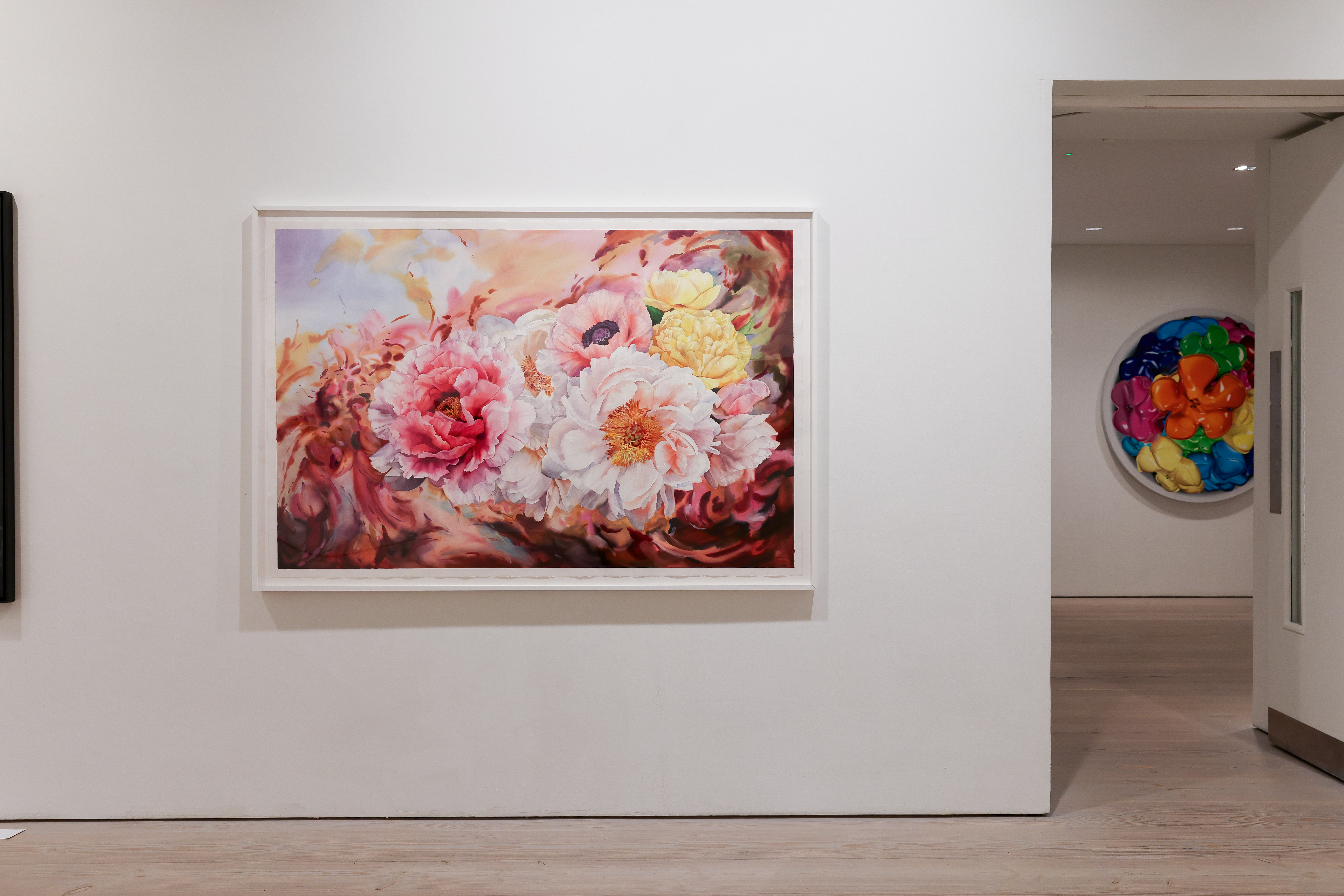

Janet Pulcho’s The Dream of Love feels like a watercolor that is striking in its originality. While many artists today use watercolor as a secondary medium, Janet Pulcho has explored it in large-scale watercolors that take your breath away when you see them in person.
This large watercolor, painted in 2024, was part of an exhibition at London’s Saatchi Gallery called Flowers – Flora in Contemporary Art and Culture. The show looked at flowers not as an art category on their own. It explored flowers as a subject that pops up everywhere in art, fashion, design, and popular culture. In that context, Pulcho’s work stood out. It’s rich, detailed, and openly romantic.
The Dream of Love is quite big, 126 × 189 cm, which is unusually large for a watercolor. The flowers are so big they don’t feel like they’re part of a life anymore. They begin to feel like a landscape. When looking at a neatly arranged bouquet, you’re faced with layers of delicate petals and leaves.

There’s an enjoyment in that. Pulcho is clearly captivated by how flowers are put together, and she spends a lot of time on them. Petals overlap, fold and curl into each other. The centers of the flowers are captivating in their detail. Color seems to flow across the surface rather than just filling it in. The result is between a study of plants and pure imagination.
That difference is important. Pulcho isn’t creating botanical illustrations. The flowers are larger and arranged in a theatrical composition. The flower size matters less than the impact of the whole painting.
This painting is part of Pulcho’s Renaissance series, and its title tells you how to approach it. It’s not about flowers. It’s about a state of love. Pulcho mentioned that the work was inspired by the myth of Zephyrus and Flora. Zephyrus, the west wind, falls for Flora, the goddess of flowers and spring. In Pulcho’s version, their story becomes about spring’s arrival and how love transforms the world.
The original myths have a side. In Ovid’s Fasti, Flora recounts how Zephyrus pursued and took her by force before marrying her. Pulcho’s modern version skips this violence. Focuses instead on rebirth and harmony.
Nothing in The Dream of Love looks like it’s dying. There are no damaged petals. The flowers, enveloped in vibrant abstract brushstrokes, seem to dance in the embrace of a warm spring breeze. The background, painted in warm tones, creates an atmosphere of comfort and joy, reminiscent of gentle sunlight caressing the skin, awakening spring hopes and dreams in the soul.
This is what distinguishes Pulcho’s paintings from the works of other artists who paint flowers..
Her flowers are not just symbols of a world in decline. Rather, they embody pure beauty. When you look at the painting, you can sense the artist’s profound connection to nature.

While this perspective may appear somewhat conventional, especially within the context of a prominent contemporary art exhibition, it is precisely this element that lends the work its distinctive character. Pulcho explores the cultural notion of beauty and tries to create a space where that concept can flourish once more.
The title, The Dream of Love, is important for this painting. Pulcho didn’t call the painting Love or Flora and Zephyrus. It’s a dream, and dreams don’t have to follow the rules of the real world. They can be sentimental and idealized. The abundance of flowers makes sense in those terms.
The size of the watercolor adds to this quality. Watercolor is usually seen as delicate. Pulcho makes it feel more enveloping. When you stand in front of the piece, you’re met with flowers that are almost too big to take in individually. The image influences the view through color and feeling first. Only then through its details.
The promising direction for Pulcho would be to introduce some tension into this beauty without losing it. The history of flowers in art is rich partly because beauty has never been as simple as it seems. Flowers have represented sexuality, mortality, power, social status, religious ideas and even colonial history. They can be both attractive and unsettling.
Pulcho already has the tools to explore that. Her oversized flowers are powerful because they are so alluring.
The Dream of Love takes this approach. It enlarges the flower instead of questioning it, embraces decoration instead of avoiding it. And it shares beauty as something meaningful rather than something to be explained away.
There’s something about that approach. Contemporary art doesn’t always have to point out what’s wrong with the world. Sometimes an artist can create a painting about longing for a world where things are at least stable for a while.
Janet Pulcho’s The Dream of Love offers not a retelling of a myth nor a radical new take on the flower image, but a carefully crafted fantasy of renewal.