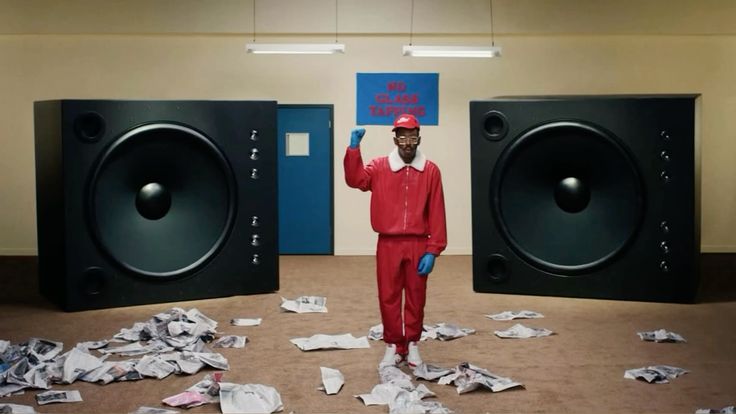

Late October brought Tyler, the Creator’s eighth studio album, and two weeks on, the verdict is already in: it’s a hit, critically and commercially. But an album cycle feels like the wrong unit to measure this artist by. To really get at what makes him tick, you have to zoom out to the full fifteen years — and the tangle of alter egos — that got him here.
Tyler Okonma is, by any commercial measure, one of the defining hip-hop artists of his generation. Fashion houses from Converse to Louis Vuitton have lined up to work with him. He’s the internet’s favorite goofball, disarming and quick to laugh, and for plenty of young Black men, he’s become an unlikely role model for exploring the messier, less-defined edges of their own sexuality. He’s also, genre labels be damned, one of the people who quietly rewired what pop music sounded like in the 2020s.
He is also — and this is the same person, not a contradiction to be resolved — a troll. A provocateur who’s flirted with conspiracy theories, slung slurs, and mocked the very idea that words online can cause real harm. In one of his more infamous tweets, he waved off cyberbullying as something you could simply blink away, as if hostility on a screen didn’t count as hostility at all.
Nobody can draw a clean line between Tyler Okonma the person and Tyler, the Creator the persona — least of all Tyler himself. And it’s hard to shake the feeling that the blur is the point. Somehow, a man who’s been under the industry microscope since he was 17 — since the tail end of the 2000s — has managed to stay genuinely hard to pin down. That’s a rare trick. Call him a creator in the fullest, least ironic sense of the word: not a content machine, but someone actually building something.

From MySpace to “I Smell Panties”
Okonma grew up in Hawthorne, a suburb south of Los Angeles, bouncing between something like a dozen schools before he was out of his teens. The name “Tyler, the Creator” started life as a MySpace handle. His first official release came under a different, cruder banner entirely — a duo called I Smell Panties. It’s exactly the record you’d expect from that name: teenage friends rapping about body parts and chaos, occasionally in cartoon-chipmunk voices, over beats that sound like they were made in someone’s bedroom between classes. Eighteen minutes of throwaway shock humor — and yet, if you listen closely, you can already hear the outline of the transgressive instincts that would define his career.
The Blog-Rap Years
Tyler’s next outfit mattered a lot more. The turn of the 2010s was a golden stretch for internet-native rap on both coasts — music explicitly built for listeners who didn’t usually like rap, but engineered with real fluency in the genre’s history. The scene even got its own label, one that describes distribution more than sound: blog rap.
The most obvious legacy of that era is structural — direct-to-listener distribution that cut labels out of the loop, a model that eventually gave way to cloud rap and emo rap, genres whose DNA is still all over the charts today. But there’s a second, subtler legacy: blog rap dissolved the boundary between comedy rap, rap as pure dada gesture, and rap as a genuine test of what audiences would tolerate. Das Racist would cut their own shows off mid-song to quote postcolonial theorist Gayatri Spivak, or just pivot into stand-up. Awkwafina — now a decorated, critically respected actress — was, in an earlier life, recording gleefully absurd tracks about her own body and about Asian stereotypes.

Odd Future and the Reinvention of the Rap Crew
Odd Future Wolf Gang Kill Them All — OFWGKTA, or just Odd Future — was a sprawling, loosely defined collective of roughly twenty people, anchored by Tyler and a handful of artists who’d go on to define the decade: Frank Ocean, progressive R&B’s golden boy; Syd, the queer siren of neo-soul; Earl Sweatshirt, a kind of high priest of deconstructed rap. The group barely lasted a few years in its original form, but it permanently changed what a rap group could look, sound, and function like. There were precedents, sure — the fluid, ever-shifting Wu-Tang Clan lineup comes to mind — but Odd Future reinvented the format as something between an art commune, a party-planning committee, and a punk label. The group’s infantile, deliberately broken aesthetic left fingerprints on every member’s later solo work, but nowhere more directly than in Tyler’s own early solo albums. It’s no accident his fashion label’s name, GOLF WANG, is an anagram of Wolf Gang — the same guy who once fronted I Smell Panties also sells clothes under a name that reads like a dirty joke if you squint.
“Yonkers” and the Pendulum Swing
“Yonkers,” Tyler’s first real solo hit, is a portrait of everything that would define him for the next decade — bouncing between raw self-loathing, references to Adventure Time, admissions of depression and suicidal ideation, and grief over an absent father he never got the chance to know. In the same three minutes, he threatens violence against Bruno Mars and against music critics and bloggers by name — a jab that doubles as a pun on the site Pitchfork — and drops references to real school shootings. That’s the pendulum Tyler’s writing has swung on ever since: self-destruction on one end, deliberately grotesque, cartoonish violence on the other, with no reliable signal for which one you’re supposed to believe. The production matched the unease — beats that pulled as much from ’90s horrorcore acts like Wu-Tang and Gravediggaz as from blog rap, stitched together from horror-movie samples, queasy strings, and goth-rock bass.
Is Any of It Real?
Every interview eventually circled back to the same question: how much of this is Tyler actually saying, and how much is performance? It’s the Eminem problem — Marshall Mathers versus Slim Shady — or the old Beastie Boys trick of smart, well-read guys playing dumb delinquents on record. Tyler’s stock answer was that his lyrics were stream-of-consciousness writing filtered through a depressed teenager’s voice. Then he’d go back to Twitter and publicly fantasize about Selena Gomez the moment she turned 18. That’s roughly where Tyler and Eminem part ways: Eminem has something like a switch he flips between his real self and his shock-jock alter ego, which gives him an alibi whenever a joke lands badly. Tyler doesn’t really have a switch — it’s more of a dial, with a hundred positions in between, and the fact that “Tyler” and “the Creator” are fused at the root means he doesn’t get that same cover.
The Costume Was Never Just a Costume
Building a persona you can’t fully separate from the artist — costume, mythology, backstory and all — has deep roots in Black pop music, particularly the strains of it that refuse to sit still inside one genre. And the more outrageous Tyler’s lyrics got — in 2015, they got him formally banned from entering the UK for several years — the less his output looked like straightforward rap. It’s the same move Stevie Wonder made when his records refused to commit to funk, soul, R&B, or disco, or that Herbie Hancock made when he let electro and hip-hop into jazz. Even Tyler’s signature baseball caps and ushanka hats read as a nod to Bootsy Collins’ outrageous headwear or George Clinton’s technicolor dreadlocks.
Flower Boy, IGOR, and the Turn Inward
That lineage got a lot harder to argue with once the second half of the 2010s arrived — Flower Boy, then IGOR. Post-genre pop had become the default mode of the decade by then (try pinning down exactly what genre The 1975 plays, or Doja Cat, or Coldplay’s last ten years), and Tyler was near the front of that wave. He started actually singing, leaning into a velvety baritone, alternating between abrasive and tender arrangements, and building beats out of caramel-smooth soul and gospel alongside the horrorcore and jazz-rap he’d built his name on. It looked, for a moment, like the real opening-up had finally arrived — following his friend Frank Ocean’s lead, Tyler started writing more directly about relationships, including their queer dimensions. His second true crossover hit after “Yonkers” is “Earfquake,” a tender ballad addressed to someone deliberately left unnamed and undefined, open enough that every listener fills in the blank differently. Maybe that update — an androgynous, almost Shakespearean-sonnet kind of longing — was the real Tyler all along, and everything before it was just teenage armor.